Mid-Year 2026: There Is No ‘One’ Central Valley Multifamily Market

August 21, 2026 | 

Eight counties. Thirty-two closings in six months. That is the whole Central Valley multifamily market through June 2026. When you compare these numbers with the past five years and look more closely at the deals themselves, one thing becomes clear: there is no one Central Valley multifamily market.

The Central Valley spans hundreds of miles, and the fundamentals influencing an apartment owner in Fresno can look very different from those affecting an owner in Merced, Stanislaus or Kern County. 

Across the eight counties we track, just 32 multifamily properties have closed in 2026 through June. But where those transactions occurred and what buyers paid varied significantly from one county to another.

Stanislaus County led the region with nine closings. Kern County recorded seven. Fresno County, historically one of the Valley’s most active multifamily markets, had six — down from 24 for all of last year. 

Pricing was just as divided. Median price per unit increased in Kern, Kings, and Madera Counties compared with full-year 2025 levels. Meanwhile, median pricing declined in Fresno, Merced, Stanislaus, and Tulare Counties. Same region, same six months. Very different market dynamics.

County H1 2026 Closings Median $/Unit YoY % Change Median GRM YoY % Change
Stanislaus 9 $119,565 -22% 8.51 -1%
Kern 7 $114,118 +11% 8.84 +10%
Fresno 6 $119,577 -4% 10.27 +3%
Merced 4 $92,383 -12% 8.49 -19%
Kings 3 $103,571 +10%
Madera 2 $124,032 +19% 9.38 +1%
Tulare 1 $91,200 -17% 10.54 +5%
Southern San Joaquin 0 N/A N/A N/A N/A
Total — Central Valley 32

One Region, Different Market Dynamics

The differences go beyond transaction volume and price per unit. Each Central Valley market has its own combination of housing supply, employment drivers, renter demand, investor activity, development pipeline, and historical pricing. All of these factors create very different investment environments. Here’s a snapshot by county:

  • Fresno has historically been one of the Valley’s deeper and more liquid multifamily markets, with a broad private-capital buyer pool.
  • Bakersfield and Kern County generally offer higher going-in yields, but new supply and economic conditions can create greater swings between cycles.
  • Modesto and Stanislaus County are telling one of the more interesting stories in 2026. Transaction activity has accelerated while median pricing has reset considerably from prior peaks.
  • Merced is a smaller market where limited transaction volume makes individual sales especially important when determining value.
  • Visalia and Tulare County have their own supply, development, and affordability dynamics, with few transactions so far this year, making it difficult to establish a clear pricing trend.
  • Southern San Joaquin County is influenced by a different set of demand drivers, including proximity to the Bay Area.

These properties may all be classified as Central Valley multifamily, but that doesn’t mean they should be valued, marketed, or underwritten the same way.

Why This Matters for Owners and Investors

Recognizing these market differences becomes especially important when owners are deciding whether to hold, refinance, sell, or exchange a property. A regional average can provide context, but it can’t tell you what your property is worth.

For example, through the first half of 2026, Stanislaus County recorded more multifamily closings than any other county we track. At the same time, its median price per unit was nearly 22% below the full-year 2025 median. While those two statistics may sound contradictory, they provide valuable insight into the Stanislaus market: buyers and sellers are finding common ground at today’s pricing.

Compare that with a market where very few properties have sold. A reported increase or decrease in median price might be based on only one or two transactions. That doesn’t necessarily mean property values across the market moved by the same percentage.

Context matters.

So does knowing which comparable sales actually apply to your property.

Going Deeper

In the upcoming weeks, I’m going to take a closer look at the individual multifamily markets that make up the Central Valley. I’ll address one of the most important questions in today’s market: What does the data actually mean for an owner deciding what to do next?

Follow along on LinkedIn or subscribe to receive each county report as it publishes.

After years of elevated interest rates and lower transaction volume, the question isn’t simply whether the Central Valley multifamily market is “up” or “down.” It’s where your property sits within it, and that answer can look different from one county to the next.

If you own multifamily anywhere in the Central Valley and want to better understand what your local market is signaling heading into the second half of the year, I’d welcome the conversation.


Dustin Ilic, CCIM
Multi-Family Investment Advisor
Visintainer Group
CA License 01772625

Subscribe to my Apartment Market Update newsletter!


This post is for general informational purposes and reflects transaction data believed accurate as of mid-2026. It is not investment, tax, or legal advice. Figures are preliminary and may be revised as additional closings are recorded and verified.

Multifamily Insurance: What Property Owners Need to Know in Today’s Market

August 13, 2026 | 

Insurance has become an increasingly important consideration for multifamily property owners. Rising premiums, changing underwriting requirements and more limited coverage options are affecting operating expenses—and, in some cases, creating additional challenges when owners prepare to refinance or sell a property.

To help Central Valley multifamily owners better understand the changing environment, Blake Blackburn of Visintainer Group recently hosted a webinar focused on the insurance issues we are seeing impact multifamily real estate today.

Watch the Webinar

Protect Your Multifamily Investment: What Every Owner Should Know About Insurance

The discussion provides practical guidance to help multifamily owners better navigate today’s insurance environment and understand how insurance considerations can affect the performance and marketability of their investments.

Why Insurance Matters Beyond Your Annual Premium

For multifamily owners, insurance is no longer simply an expense to review at renewal.

Higher premiums can directly affect a property’s Net Operating Income (NOI), which can ultimately influence property value. Insurance availability and costs can also become important considerations during a refinance or sale, particularly when a buyer or lender encounters unexpected coverage requirements during due diligence.

Understanding potential insurance issues before a transaction can give owners more time to address concerns rather than discovering them during escrow.

Preparing for Today’s Insurance Environment

One of the key themes of the webinar is the importance of being proactive.

Multifamily owners should understand how their property may be viewed by insurance carriers, maintain accurate property information and work with qualified insurance professionals to identify potential concerns before renewal, refinancing or a future sale.

For owners considering selling, refinancing or evaluating the performance of a multifamily investment, insurance should increasingly be part of the broader conversation about the property’s financial position.

Have Questions About Your Multifamily Investment?

While Visintainer Group is not an insurance brokerage and does not provide insurance advice, our multifamily team works closely with property owners throughout the Central Valley and sees firsthand how changing insurance conditions can affect investment performance and real estate transactions.

If you have questions about your multifamily property, its current market value or how today’s investment environment may affect your plans, contact Blake Blackburn and the Visintainer Group Multifamily Team.


Blake Blackburn
Multifamily Investment Advisor

559.669.3686

blake@visintainergroup.com

Agent DRE# 02171472


The information provided in this webinar and article is for general informational purposes only and should not be considered insurance advice. Property owners should consult with a qualified insurance professional regarding their specific property and coverage needs.

Visintainer Group Brokers $20.85 Million Sale of Cedar Tree Village Shopping Center in Fresno

July 24, 2026 | 

Visintainer Group has successfully brokered the sale of Cedar Tree Village Shopping Center, a 118,417-square-foot grocery-anchored retail center in Fresno, California, for $20,850,000, making it one of the largest retail investment transactions in the Central Valley during 2026.

Located at the southeast corner of Herndon Avenue and Cedar Avenue, the shopping center sold at its full asking price after a competitive marketing process that generated seven qualified offers from investors throughout California. The property was sold by Cedar Tree Village, LLC to Irvine-based Pacific Castle PM, Inc., with the transaction closing on July 16, 2026.

The seller was represented exclusively by Brett Visintainer, CCIM, Principal, and John Kourafas, CCIM, Commercial Investment Advisor, of Visintainer Group.

Strong Investor Demand for Grocery-Anchored Retail in Fresno

Investor interest was driven by Cedar Tree Village’s exceptional operating history, high-quality tenancy, and irreplaceable infill location within one of Fresno’s strongest retail corridors.

More than 58% of the occupied square footage has been leased by tenants for over ten years, demonstrating long-term tenant stability. Prior to the sale, ownership further enhanced the property’s investment profile by securing long-term lease extensions with McDonald’s, R-N Market, and Dollar Tree, while also completing a full parking lot resurfacing and restriping in 2025.

The offering represented one of the few opportunities in recent years to acquire a grocery-anchored shopping center of this size under single ownership in the Fresno market. Combined with necessity-based retailers, a loyal neighborhood customer base, and strong occupancy, the center attracted significant interest from institutional and private investors seeking stable, long-term retail assets.

One of the Central Valley’s Largest Retail Sales of 2026

According to CoStar, the transaction ranks as the second-largest retail investment sale in the Central Valley during 2026, trailing only the Riverview Shopping Center sale in Fresno. Among stabilized shopping center transactions exceeding $10 million, Cedar Tree Village also achieved the lowest cap rate recorded in the Central Valley this year, highlighting continued investor confidence in well-located retail properties and the strength of the Fresno investment market.

Read More

The sale was also featured by The Business Journal, which highlights additional details about the transaction, buyer, and market significance.

Read the coverage here: The Business Journal: Cedar Tree Village shopping center sells for $20.85M in Fresno

Learn more about our:

What does a typical Central Valley 20-unit apartment building actually earn in 2026?

July 16, 2026 | 

Many owners of a 20-unit complex can tell you their rent roll to the dollar. Ask them what the building actually nets after every real expense and today’s debt, and the number gets fuzzy. That gap—between gross rent and what lands in your pocket—is where sale prices are won and lost, and in 2026 it’s wider than it’s been in years.

Here’s an honest, line-by-line look at a representative Central Valley 20-unit, built on current market figures. Once you see how the math is structured, you can plug in your own numbers and stop guessing.

First, how your building is actually valued

Owners tend to value their property one of two ways: what the one down the street sold for, or what they paid plus what they’ve put in. Buyers don’t care about either. A 20-unit is valued off its income less any discovered deferred maintenance, using one formula:

Value = Net Operating Income ÷ Cap Rate

Net Operating Income (NOI) is what’s left after operating expenses but before your mortgage. The cap rate is what the market will pay for that income stream today. Right now, Class B/C multifamily in markets like ours is trading in roughly the 6.25%–6.75% range—up meaningfully from a few years ago, which means the same NOI is worth less than it used to be. When people say “prices softened,” this is the mechanism.

The representative building

Illustrative Class B/C 20-unit, older Central Valley stock. 

  • 20 units, blended in-place rent of $1,350/month
  • Owner pays water, sewer, and trash (common for older stock here)
  • Cap rate: 6.5% | Financing: 30% down, 6.5% rate, 30-year amortization

The income

Line Annual
Gross potential rent (20 × $1,350 × 12) $324,000
Other income (laundry, pet, fees) $9,000
Gross Scheduled Income $333,000
Vacancy & credit loss (6%) ($20,000)
Effective Gross Income $313,000


Note the vacancy line. Owners love to run numbers at 100% occupancy. No one operates at 100%—between turns, non-payment, and concessions, 5–7% is the honest figure for older stock, and a buyer will underwrite it that way whether you do or not.

The expenses owners routinely underestimate

Expense Annual
Property taxes (reassessed at sale, ~1.2%) $36,000
Insurance $18,000
Property management (6% of EGI) $18,800
Repairs & maintenance $22,000
Utilities (owner-paid water/sewer/trash) $28,000
Turnover & make-ready $5,000
Capital reserves $6,000
Admin, legal, misc. $5,000
Total operating expenses $138,800


That’s about 44% of effective income—right in the normal 40–45% band for older Central Valley multifamily. If your expense ratio looks a lot lower, you’re probably missing something a buyer’s lender won’t.

What’s left: NOI and Value

NOI = $313,000 − $138,800 = ~$174,000
Value = $174,000 ÷ 6.5% = ~$2.67 million (about $134,000/unit)

That’s the number a buyer starts from—not price per unit, not the comp down the street.
Now the part that decides whether it’s worth owning: the debt
Valuation is unlevered. Your actual return depends on financing, and this is where 2026 bites.

Purchase price: ~$2.67M | 35% down = $934,500 cash in
Loan: $1.73M at 6.5% interest over 30 years → $131,635/year in debt service
Cash flow before tax = $174,000 NOI − $131,635 debt = $42,365/year
Cash-on-cash return = $42,365 ÷ $934,500 = 4.53%

A 20-unit that feels like it should throw off serious cash nets about $42,362 a year in pre-tax cash flow at today’s rates—a 4.5% cash-on-cash return. And the debt-service coverage ratio (NOI ÷ debt) lands at 1.32, right at the edge of what most lenders require. At today’s rates, this deal hardly pencils at 35% down. That’s not pessimism—it’s exactly why buyers now demand higher cap rates (lower prices) than they did in 2023.

What this means for you

If you’re holding, understand that your real return lives in the spread between your NOI and your debt—and that operating discipline (occupancy, expense control, reserves) moves value more than hoping for the market to bail you out.

If you’re thinking about selling, understand that a buyer is running this exact math backward from your NOI. Every soft expense you’ve ignored and every below-market rent you’ve let ride is already priced into their offer. The owners who net the most at sale are the ones who tighten operations and take care of any deferred maintenance issues 12–18 months before they list, not 1 month before they call a broker.

These figures are illustrative and built on early-2026 Central Valley market data—not an appraisal or an offer. Every building has its own rents, expenses, and debt. If you want to see what your specific property nets today, and what it would trade for in this market, I’ll run the real numbers with you.

Dustin Ilic, CCIM
Multi-Family Investment Advisor
Visintainer Group
CA License 01772625

Subscribe to my Apartment Market Update newsletter!


Continue reading more updates from Dustin:

Learn more about our:

Dustin Ilic Featured in The Business Journal Discussing Strong Multifamily Investor Demand

June 18, 2026 | 

Dustin Ilic was recently featured in The Business Journal discussing investor demand in the Central Valley multifamily market and two recent transactions completed in Fresno and Visalia.

Key Takeaways

  • Strong demand remains for smaller multifamily properties.
  • Well-maintained assets continue to attract multiple offers.
  • Local investors are actively pursuing long-term hold opportunities.
  • Limited inventory is helping support pricing in Fresno and Visalia.

Recent Transactions Highlighted

Visalia – 3220-3226 S. Villa Street

  • 4 units
  • Built in 2017
  • Multiple offers
  • Closed in 14 days
  • Sold for $935,000

Fresno – Augusta Street

  • 6 units
  • Sold for $950,000
  • Townhome-style unit mix
  • Strong local investor demand

Market Outlook
According to Dustin, interest rates and rental rate trends will be two of the most important factors influencing multifamily investment activity throughout the remainder of 2026.

Read the Full Article from The Business Journal


Continue reading more updates from Dustin:

Learn more about our:

How Higher Treasury Yields Affect Central Valley Multifamily Owners

June 04, 2026 | 

If you own a Central Valley multifamily property with a loan maturing in the next 12–24 months, there is one number you should be watching closely: the U.S. Treasury yield.

Treasury yields serve as the foundation for commercial real estate lending. When yields move higher, borrowing costs typically move higher as well. And while rates have moved around over the past year, they’re still well above the levels many owners enjoyed when they financed between 2020 and 2022.

For Central Valley multifamily owners with upcoming loan maturities, that creates a challenge.

A loan that was financed at 3.5%–5.0% several years ago may need to be refinanced into a significantly higher rate environment today. Even if your property is performing well, higher debt service can reduce cash flow and impact loan proceeds.
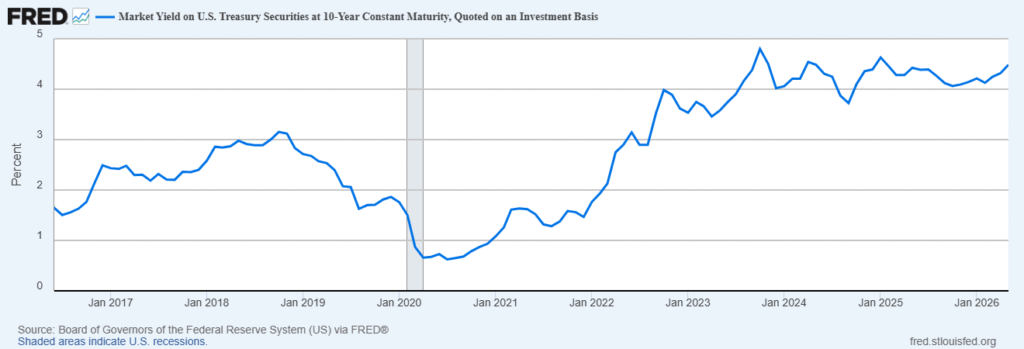
This relationship between Treasury yields, borrowing costs, and property values is not new. In fact, we discussed how rising interest rates impact commercial real estate pricing, cap rates, and leverage several years ago in our article, What to Know About Interest Rates and Commercial Real Estate. While today’s market conditions are different, many of the same lending fundamentals continue to influence investment decisions.

What does this mean?

  1. Reduced Cash Flow
    Higher interest rates generally mean higher monthly payments.
    For many owners, that translates into lower distributions and tighter operating margins, even if occupancy and rents remain stable.
  2. Debt Service Coverage Challenges
    Most lenders require a Debt Service Coverage Ratio (DSCR) of approximately 1.20x to 1.25x.
    If your property’s net operating income doesn’t support the new loan payment, a lender may reduce proceeds, require a principal paydown, or ask for additional equity at closing.

Those conversations are much easier to have six months before maturity than sixty days before maturity.

We’ve recently seen this challenge play out firsthand with multifamily owners facing loan maturities after securing historically low interest rates. In our case study, Multifamily Loan Maturity: What to Do When Your Rate Jumps from 2.9% to 6%, we walk through how one owner evaluated refinancing versus repositioning their investment to better align with today’s lending environment.

If my loan matures in the next 12-24 months, what should I be doing today?

If You’re Planning to Refinance
Here are a few steps worth taking now:

    • Run your property’s DSCR using today’s lending assumptions.
    • Make sure your rent roll and trailing financials are accurate and current.
    • Speak with multiple lending sources early. Agency lenders, banks, and other capital providers can have materially different terms.
    • Evaluate whether interest rate buy-downs or alternative loan structures make sense for your investment goals.
    • Begin the process well before maturity to preserve flexibility and negotiating leverage.


If Refinancing Doesn’t Make Sense

Refinancing isn’t the only option. Depending on your goals, you may also consider:

    • Negotiating a loan extension with your current lender.
    • Selling before maturity pressure limits your options.
    • Completing a 1031 exchange into an asset that better aligns with today’s financing environment.
    • Bringing in additional equity or a capital partner to strengthen the balance sheet.

Every property is different, which is why it’s important to evaluate multiple paths before you’re forced into a decision.

The Bottom Line
The owners navigating today’s market most successfully aren’t waiting for their maturity date to arrive. They’re evaluating their options early, understanding their refinance exposure, and making decisions from a position of strength.

If you’d like a second opinion on your property’s refinance outlook, sale potential, or 1031 exchange opportunities, I’d be happy to help. A brief conversation today can provide clarity well before a lender’s deadline does.


Dustin Ilic, CCIM
Multi-Family Investment Advisor
Visintainer Group
CA License 01772625

Subscribe to my Apartment Market Update newsletter!


Continue reading more updates from Dustin:

Learn more about our:

What Is Return on Equity in Multifamily Real Estate?

May 21, 2026 | 

Most multifamily owners know their rental income, occupancy, and mortgage payment.

Far fewer know their current Return on Equity (ROE).

And in today’s commercial real estate environment — with rising property values, changing interest rates, and compressed returns — that may be the most important number to understand.

Request a Complimentary ROE Analysis

I work with apartment owners across California’s Central Valley every week, and the same pattern comes up repeatedly:

The property is performing well.
The loan balance has steadily declined.
The asset has appreciated over time.

On paper, everything looks healthy.

But when I ask:

“What return are you earning on the equity currently tied up in the property?”

Most owners are not sure how to answer.

Not because they are poor operators. Because ROE is rarely discussed — even though it is one of the clearest indicators of whether your equity is still working efficiently.

What is Return on Equity (ROE) in Real Estate?

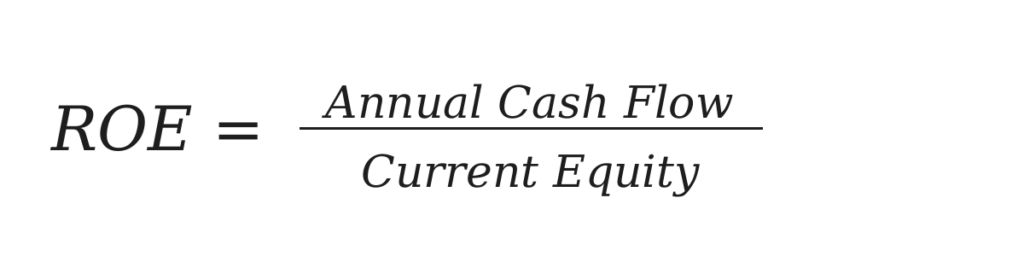
Return on Equity (ROE) measures the annual cash flow your property produces relative to the equity you currently have invested in it — not the equity you put in years ago, but what’s locked in today.

It answers a question every owner should be able to answer in one sentence: “If I sold this property today and reinvested the proceeds, would I do better, worse, or about the same?”

Unlike Cap Rate, which is a market metric tied to the property, ROE is a personal metric tied to you — your equity, your basis, your goals. Two owners can hold identical buildings on the same street with wildly different ROEs depending on:

    • When they purchased the property
    • How much debt remains
    • How much the property has appreciated
    • Their current cash flow
    • Their long-term investment goals

That is why ROE becomes especially important for long-term multifamily owners.

The Return on Equity Formula

Current Equity = today’s estimated market value minus the remaining loan balance and estimated closing costs.
Annual Cash Flow = Net Operating Income minus debt service, capital reserves, and any non-recurring items.

The math itself is relatively straightforward.

The strategy behind the number is where the conversation becomes important.

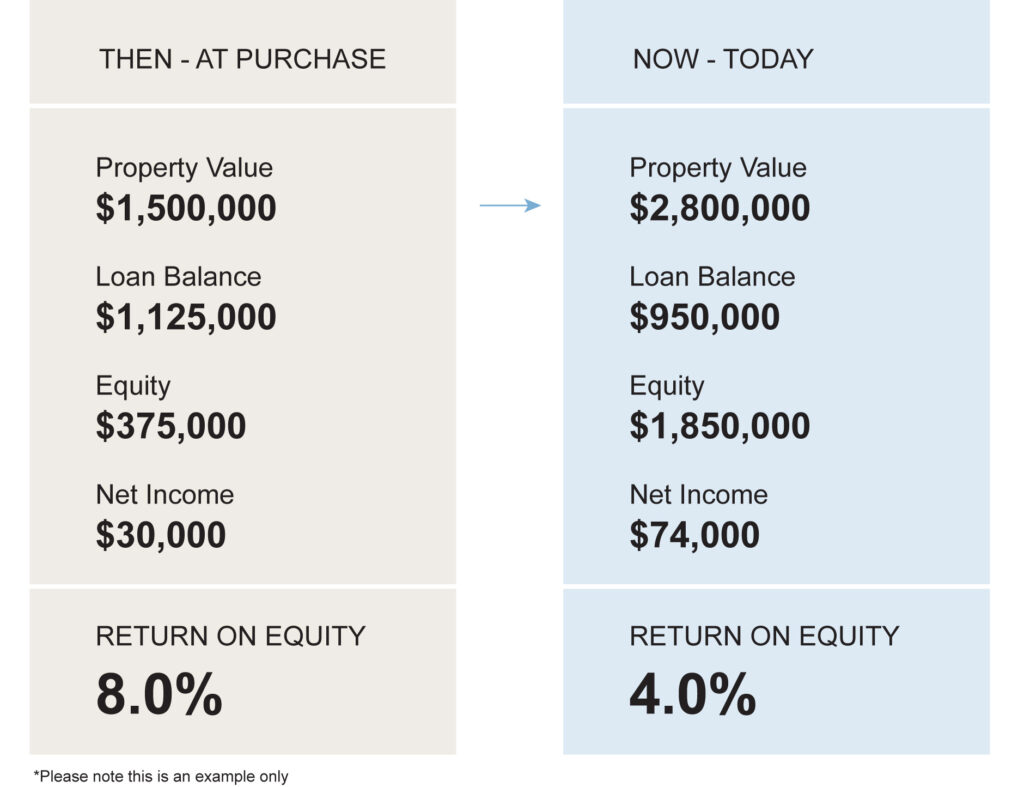
As values rise and loans pay down, equity grows — but the returns on that equity often don’t keep pace. Here’s a quick example of what that looks like:


Use our tool to calculate your Return on Equity in seconds.

Why ROE Matters for Multifamily Owners

Over time, many apartment owners experience significant appreciation while rents and cash flow grow more slowly.

As that happens, equity builds inside the property — sometimes faster than the property’s income performance.

That can create a situation where:

    • Your property appears successful
    • Your net worth increases
    • But your actual return on equity steadily declines

This is common throughout the Central Valley, especially with long-term ownership groups and legacy multifamily assets.

In many cases, owners are sitting on substantial equity while earning relatively modest returns on that equity position.

That does not automatically mean you should sell.

But it usually means the property deserves a closer review.

What Is Considered a Good Return on Equity?

There is no universal “perfect” ROE.

The right number depends on:

    • Your risk tolerance
    • Tax position
    • Debt structure
    • Estate planning considerations
    • Management intensity
    • Alternative investment opportunities

That said, many stabilized multifamily assets generally fall into ranges like these:

Below ~4% ROE

Equity may be underperforming.

This often happens when appreciation has significantly outpaced income growth. Owners may benefit from evaluating refinance opportunities, operational improvements, or a potential 1031 exchange strategy.

~4%–8% ROE

Generally stable and reasonable.

Many long-term apartment owners fall within this range. The focus becomes optimizing debt, operations, tax strategy, and long-term planning.

Above ~8% ROE

Strong relative performance.

At this level, the conversation often shifts toward protecting the asset’s position, maintaining occupancy, and preserving long-term cash flow stability.

When to run the number

ROE drifts. Markets move, loan balances drop, life changes. The number you ran two years ago has almost certainly changed. There’s no single right cadence, but four moments are worth flagging:

Every 18–24 months

A regular cadence catches drift before it compounds into a missed window.

Before a refinance

Pulling cash out changes both sides of the equation. Model it before you sign anything.

At major life events

Retirement, partnership changes, estate planning, divorce — each one shifts what “good ROE” means for you.

At market inflection points

Significant rate moves, cap rate compression, or a comparable sale nearby — any of these can change the picture quickly.

Complimentary Multifamily ROE Analysis

At Visintainer Group, we work with multifamily owners throughout California’s Central Valley to evaluate how their equity is performing in today’s market.

If you would like a complimentary Return on Equity analysis for your apartment property, we can help review:

    • Estimated market value
    • Current loan structure
    • Cash flow performance
    • Equity position
    • Reinvestment or hold strategies

The analysis is confidential, straightforward, and designed to help owners make more informed long-term decisions.

Request a Complimentary ROE Analysis

Learn more about Return on Equity.


Blake Blackburn
Multifamily Investment Advisor

blake@visintainergroup.com

Agent DRE# 02171472


Continue Reading More Updates from Blake:

Learn more about our:

Multi-Family Late Fees Just Got More Complicated in California

May 13, 2026 | 

Here’s What You Need to Know

If you own rental property in California, a recent federal court case deserves your attention… not just to stay compliant, but to avoid potential class action exposure and costly settlements.

What Happened

In Van Cott v. Equity Residential, a federal court in the Northern District of California preliminarily approved a nearly $43 million class action settlement against Equity Residential, one of the largest apartment REITs in the country, over its standard late fee structure. The fee that was challenged was not unusual. Rather, it was a 5% late fee with a $50 minimum.

The court found this structure likely unlawful under California law.

This follows a related ruling in Munguia-Brown v. Equity Residential from April 2024, which addressed tenants who were charged the same fee dating back to 2010. Together, these two cases represent more than a decade of exposure for a practice that many owners consider routine.

Why This Matters for Central Valley Owners

California law limits late fees to a “reasonable estimate” of the landlord’s actual costs of collecting late rent, rather than allowing a flat penalty. In this case, the settlement valued Equity’s “actual costs” approximately $32 per late fee charge, which is the standard the court then applied. 

If you are an apartment owner who has a late fee clause in your lease agreements, now is a good time to review it with your attorney. A fee that feels standard, or widely used, may not hold up if it isn’t tied to demonstrable, documented costs.

The Future Impact

This case is yet another signal of a regulatory environment continuing to shift toward stronger tenant protections, including the Tenant Protection Act’s rent caps, SB 567’s tightened no-fault eviction rules, and the one-month security deposit limit that took effect in 2025. Each of these individually is manageable. Taken together, they meaningfully change the operating calculus for rental housing owners in California.

The good news is that none of this makes Central Valley multifamily a bad investment. The fundamentals are still solid, vacancy remains low, and buyer demand for stabilized assets is real. However, it does make the details more important than ever: leases, fees, compliance documentation, and your positioning when it comes time to sell.

What I Recommend

Have a landlord-tenant attorney review your current lease, specifically your late fee clause, deposit language, and any no-fault termination provisions, before your next lease renewal cycle. This is a relatively low-cost step that could prevent a high-cost issue down the line.

As always, if you have questions about how the regulatory environment is affecting valuations or your options as an owner, I’m happy to talk through it.

Dustin Ilic, CCIM
Multi-Family Investment Advisor
Visintainer Group
CA License 01772625

Subscribe to my Apartment Market Update newsletter!


Continue reading more updates from Dustin:

Learn more about our:


Fresno County Real Estate Outlook: Key Insights from the Real Estate Forecast

April 27, 2026 | 

I recently had the opportunity to join an outstanding panel at the 21st Annual Real Estate Forecast hosted by the Fresno County Economic Development Corporation. This annual event continues to bring together leaders across agriculture, industrial, multifamily, residential, retail, and office sectors to discuss the current state—and future direction—of real estate in Fresno County.

From my perspective in commercial investment, the conversation centered on market stabilization, shifting investor behavior, and where opportunity is beginning to re-emerge.

Where the Market Stands Today

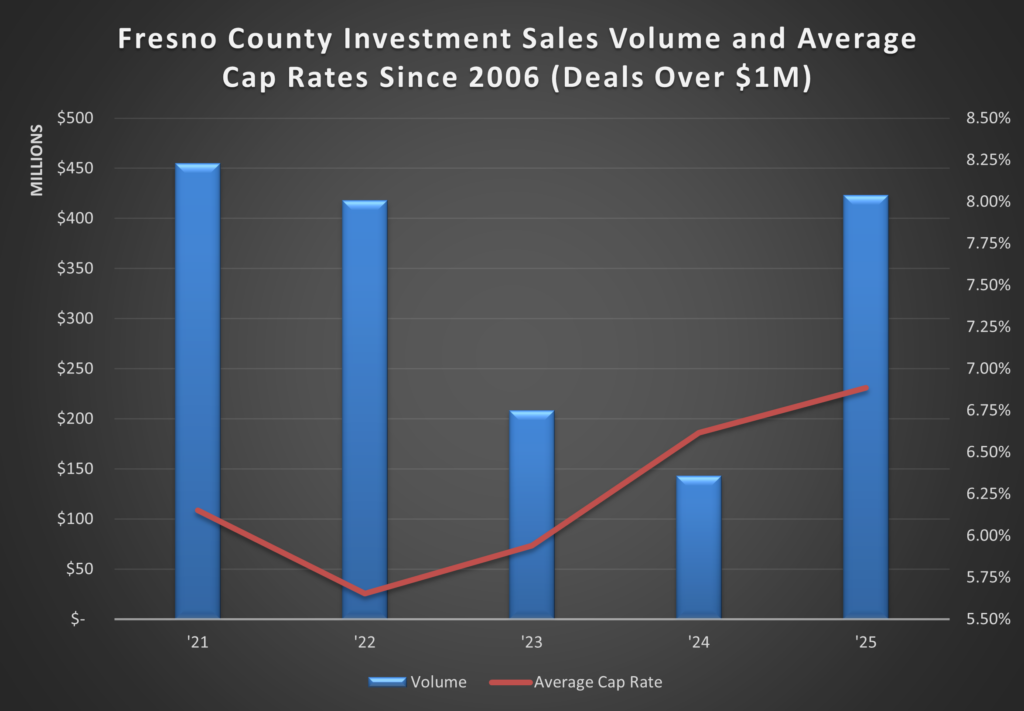
Over the past three years, we’ve seen cap rates rise—translating to a decline in property values from the historic highs of 2022. However, what’s important today is not just where we are—but how the market is adjusting.

The pace of cap rate increases has slowed, signaling that volatility is easing and we may be entering a more stable phase of the cycle.

Interest rates have remained relatively consistent in the 6.00–6.50% range over the past two years. While elevated compared to prior cycles, consistency is something investors value—and that stability is helping bring capital back into the market.

The data tells this story clearly:

While cap rates have climbed, the rate of increase is moderating—pointing toward a potential stabilization in pricing. At the same time, we’re seeing sales volume begin to recover, an early indicator of renewed investor confidence.

Market Validation from the Field

This trend isn’t just theoretical—it’s playing out in real time.

In an interview with GV Wire, I shared how investors have adapted to today’s interest rate environment and are actively identifying opportunities as pricing resets.

GV Wire – Fresno County EDC Real Estate Forecast 2026

Even with broader economic headwinds, investors are recognizing that markets like Fresno offer relative stability and value compared to more volatile, high-cost regions.

Momentum Backed by Real Data

The numbers reinforce what we’re seeing across the market:

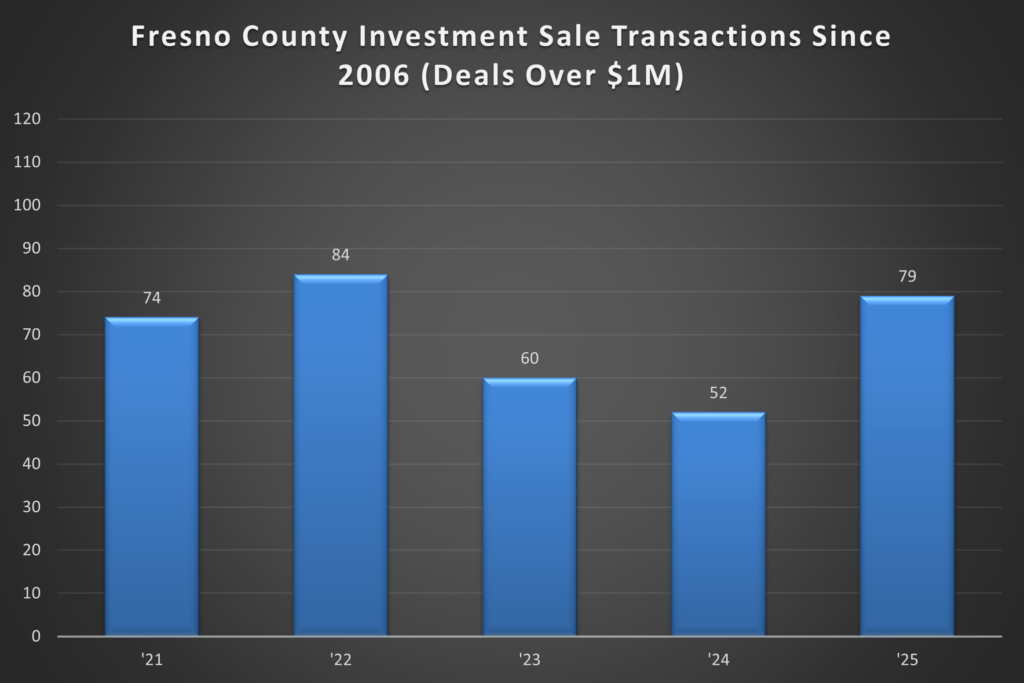
  • Real estate transactions increased by 52% in 2025
  • Fresno County recorded 79 investment transactions totaling over $400 million
  • This marks a significant increase from 2024’s 52 transactions and sub-$150 million volume

Transaction activity further highlights the market’s rebound:

After a dip in activity, the sharp increase in transactions signals that buyers and sellers are finding alignment again—an important indicator of a functioning, healthy market.

We’re also seeing strong competition on individual assets. A recent example is the Cedar Tree Shopping Center, which received seven offers from both local and national buyers—demonstrating the depth of demand returning to the Central Valley.

Why Investors Are Turning to the Valley

Investors today are looking beyond traditional “core” markets and focusing on regions that offer stronger fundamentals and better relative value.

Fresno continues to stand out because of:

  • More attractive pricing compared to coastal markets
  • Consistent performance metrics
  • Opportunities to acquire assets below peak valuations

At the same time, lenders are becoming more active. Many institutions are increasing their allocations toward real estate, creating more competition among lenders and improving financing availability.

Strategy Matters More Than Ever

One of the most important takeaways I shared during the panel is that strategy must be intentional.

Every client conversation starts with understanding their position:

  • Are they planning to sell within 12 months?
  • Do they have upcoming loan maturities?
  • Are they repositioning or simplifying their portfolio?
  • Are they planning for generational wealth transfer?

Even holding a property is a decision—and it should be evaluated annually.

I often compare real estate to stocks: investors regularly assess performance and reallocate capital. Commercial real estate should be approached with that same level of discipline.

Preparing Assets for Today’s Buyers

In today’s market, preparation plays a critical role in maximizing value.

Key strategies include:

  • Securing longer-term leases—even if it requires short-term incentives
  • Renewing tenants early to strengthen income stability
  • Completing third-party reports prior to marketing
  • Building a comprehensive due diligence package

The more clarity and confidence you provide upfront, the stronger your position becomes during negotiations—and the less risk of deal disruption.

Capital Markets: A Shift Beneath the Surface

Another key dynamic shaping today’s market is the lending environment.

We’re seeing:

  • Increased capital availability from banks, life insurance companies, and private lenders
  • Growing competition among lenders
  • Expanding allocations toward real estate lending

Even with relatively stable treasury benchmarks, this increased competition is beginning to compress spreads—creating more favorable borrowing conditions for investors.

Asset preferences remain consistent:

  • Multifamily, industrial, essential retail, and medical assets lead
  • Office remains challenged but is gradually gaining acceptance


Final Thoughts

The Fresno County real estate market is no longer paused—it’s evolving.

We’re seeing:

  • A return of capital
  • Increased transaction activity
  • Greater pricing clarity

As both pricing trends and transaction data illustrate, the market is entering a more balanced—and increasingly investable—phase of the cycle.

For those who remain proactive and strategic, this environment presents real opportunity.

The market is rewarding those who adapt—not those who wait.


Continue Reading More from John Kourafas, CCIM:

Learn more about our:

Visintainer Group Surpasses $1 Billion in Commercial Real Estate Investment Transactions

April 23, 2026 | 

Visintainer Group, a leading commercial real estate brokerage and advisory firm based in Fresno, California, proudly announced that it has surpassed $1 billion in total investment sales volume, marking a significant milestone for the firm. In 2022, Visintainer Group eclipsed $500 million in commercial real estate investment sales.

Specializing in commercial, multifamily, and 1031 exchange real estate solutions, Visintainer Group has successfully advised clients on the acquisition, disposition, and exchange of more than 250 properties across 18 states, reflecting both the firm’s deep Central Valley roots and established national footprint.

“This milestone is a reflection of the trust our clients place in us and the consistency of our team’s execution,” said Brett Visintainer, CCIM, Principal of Visintainer Group. “Since day one, our focus has been on delivering strategic, client-first solutions that help investors grow and preserve wealth through real estate. Reaching $1 billion is meaningful, but what matters most is how we got here—through relationships, discipline, and results.”

While the firm maintains a strong presence in California’s Central Valley, its reach extends well beyond the region. Leveraging a robust national network of brokers, owners, and developers, Visintainer Group has facilitated a substantial volume of off-market and out-of-state transactions, creating unique opportunities for clients seeking diversification and access to high-quality investment assets.

“Our growth has been intentional,” added Visintainer. “We’ve built a platform that combines local market expertise with national connectivity, allowing us to uncover opportunities others simply don’t see. As we look ahead, we remain focused on expanding our capabilities, strengthening our relationships, and continuing to deliver best-in-class advisory services to our clients.”

The firm’s success is driven by its comprehensive approach to investment real estate, including tailored acquisition and disposition strategies, 1031 exchange advisory, and a proprietary database of buyers, sellers, and investment opportunities—exclusively developed and curated in-house by Visintainer Group.

Listings Update

Please enter the following information to be notified about new listings, price changes, and listing updates.